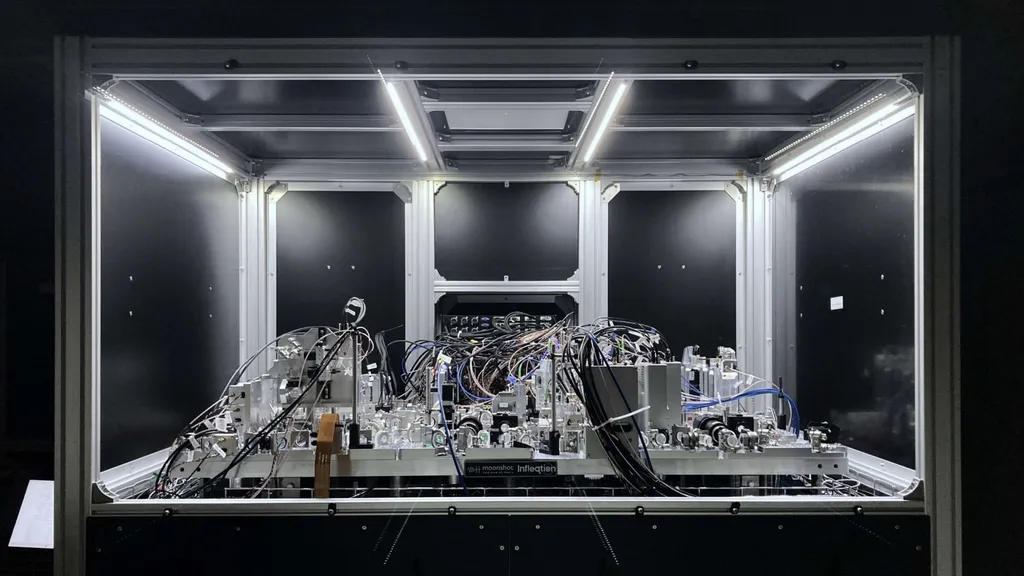








Say ‘Konnichiwa’ to Japan’s First Neutral-Atom Quantum Computer

Japan recently unveiled “Shunkai”, its first full-stack neutral-atom quantum computer, marking a major step forward in the country’s quantum technology landscape.
Developed by the Institute for Molecular Science (IMS) in collaboration with Hitachi and US-based tech firm Infleqtion, the system relies on individual neutral atoms suspended by laser light (“optical tweezers”) rather than traditional superconducting circuits. Crucially, this neutral-atom – an atom with no net electric charge – modality allows Shunkai to operate at room temperature, bypassing the massive, costly cryogenic refrigeration systems required by competitors.
As a “full-stack” machine, Shunkai integrates all hardware, control and software layers needed to translate human inputs into processed quantum outputs. Initially operating with roughly 50 physical qubits, the system will soon scale to 500 qubits.
Professor Kenji Ohmori’s Okazaki-based team, in collaboration under Japan’s Moonshot research and development program, has set an ambitious target to scale the system into a fault-tolerant, 10 000-qubit machine by March 2031.
Because neutral atoms can be physically repositioned during calculations, the architecture provides flexible “any-to-any” qubit connectivity. This makes Shunkai an ideal testing ground for quantum error correction, a major hurdle in preventing fragile quantum data from degrading.
The quantum computing system is named after the 17th-century Edo-period astronomer Harumi Shibukawa; Shunkai will be made available to external researchers and integrated into a shared supercomputing facility to establish a hybrid computing center.
Image Credit: Source