







China’s Fusion Reactor Blasts Through Density Records
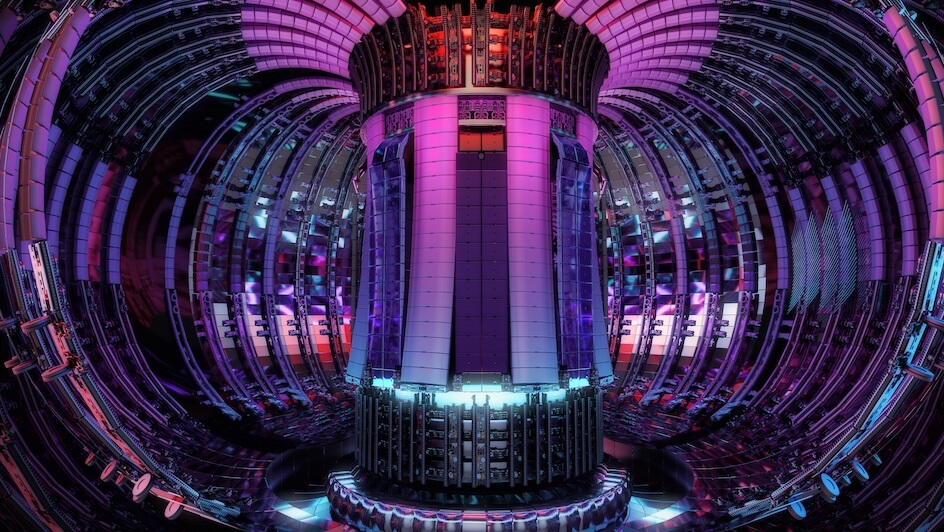
China’s Experimental Advanced Superconducting Tokamak (EAST) has achieved a major milestone by surpassing a fundamental density limit in nuclear fusion.
For the first time, scientists operating the “Artificial Sun” entered a “density-free regime,” maintaining stable plasma at 1.3 to 1.65 times the Greenwald limit.
The Greenwald limit has long been an empirical ceiling for tokamak reactors (large doughnut-shaped devices that use magnetic fields to confine plasma). Exceeding this density typically triggers instabilities that can stop the fusion reaction. However, higher density is essential for a higher fusion rate, which brings reactors closer to the “ignition” point where the process becomes self-sustaining.
To achieve this, the team at the Chinese Academy of Sciences (CAS) carefully manipulated gas pressure and electron cyclotron resonance heating – tuning how plasma particles respond to microwaves. This allowed the matter to enter a state of “self-organisation,” balancing its interaction with the reactor walls to prevent collapse.
Professor Ping Zhu, the EAST study’s co-author, explained in a CAS statement: “The findings suggest a practical and scalable pathway for extending density limits in tokamaks and next-generation burning plasma fusion devices.”
The achievement bodes well for the world’s largest tokamak, currently under construction in France, resulting from the collaborative work of over a dozen countries in the International Thermonuclear Experimental Reactor program.
While fusion energy remains an experimental science – and is unlikely to see practical usage within a decade – this milestone provides a vital roadmap for a future powered by near-limitless, carbon-free energy.